
In most supernatural stories, the war is fought with fangs, spells, and ancient prophecies.
In Legacies, the most brutal fight is quieter — the fight to grow up while carrying the weight of impossible expectations.
Set in the aftermath of The Originals, the series shifts the spotlight from legendary villains to fragile heirs. At the heart of it all stands Hope Mikaelson, the only tribrid in existence — vampire, werewolf, and witch — a living contradiction born from power and loss. But Legacies is careful not to treat her as a weapon. Instead, it frames her as a young woman terrified that loving others will only lead to more funerals.
And that fear shapes everything.

A School Built on Survival
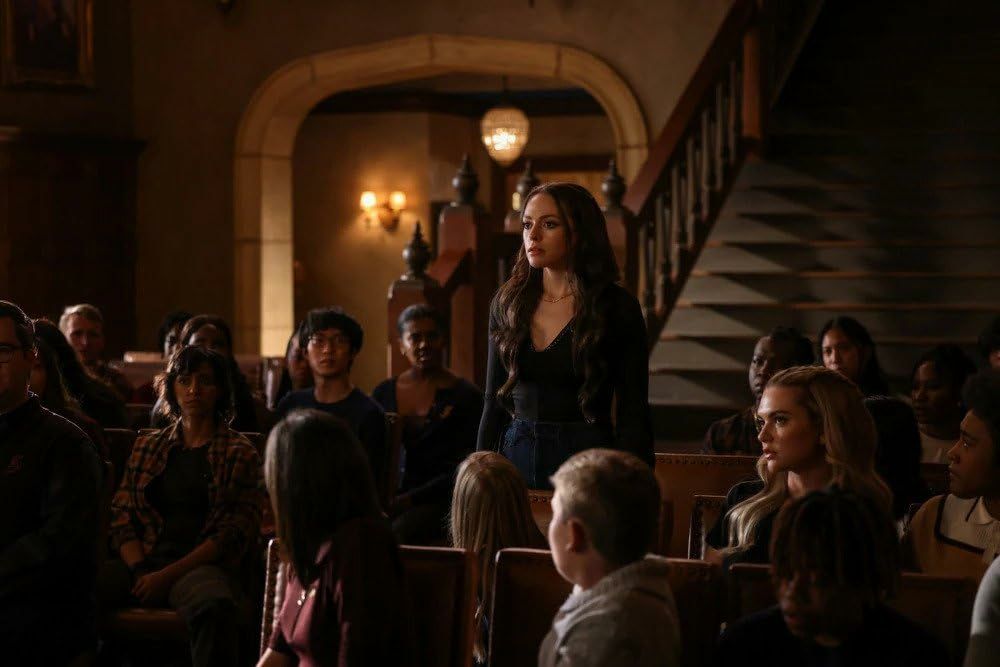
The Salvatore School is not just a setting — it is a fragile experiment. A place designed to teach supernatural teenagers how to control their abilities, but also how to coexist with a world that would never fully accept them. In its hallways, friendships form under the shadow of extinction, and romance unfolds beside ancient curses.
Every student carries a bloodline.
Every bloodline carries history.
And history, in this universe, is never gentle.
The show blends monster-of-the-week storytelling with long-form emotional arcs, using creatures and spells as metaphors for isolation, anger, addiction, and identity. What appears at first to be a light-toned fantasy slowly reveals itself as a coming-of-age drama about children forced to become guardians of a dying magical world.

Hope Mikaelson: Power as a Prison
Hope’s greatest tragedy is not her enemies — it is her belief that she must face them alone. Descended from the most feared family in supernatural history, she internalizes the idea that survival requires sacrifice. Over time, that mindset pushes her toward isolation, emotional withdrawal, and self-destruction disguised as heroism.
In many ways, Legacies asks a haunting question:
What happens when the savior no longer believes she deserves to be saved?
Danielle Rose Russell’s performance grounds the fantasy in something painfully human — grief that never fully heals, and love that feels too dangerous to trust.
Friendship as the True Magic
While battles rage and villains rise, the emotional backbone of Legacies remains its friendships. Lizzie and Josie Saltzman, caught between rivalry and devotion. Landon Kirby, constantly questioning whether he is strong enough to stand beside someone born legendary. MG, Kaleb, Cleo — each fighting to define themselves beyond their supernatural labels.
The series repeatedly returns to the idea that legacy is not only about blood, but about the people who choose to stand with you when the world turns hostile.
In a franchise long known for epic romances, Legacies dares to say that friendship may be the most radical form of loyalty.

An Ending That Feels Like a Beginning
When the series ended in 2022 due to network restructuring, the story reached emotional closure — but not narrative exhaustion. The world of Mystic Falls still breathed with unresolved political tensions, fractured covens, and young heroes only beginning to understand the consequences of their power.
That is why rumors of continuations and imagined sequels continue to circulate online. Not because of official announcements, but because the universe itself still feels alive.
And audiences can sense unfinished worlds.

Why Legacies Still Resonates
In an era of darker, grittier fantasy, Legacies chose vulnerability. It spoke to a generation navigating identity, anxiety, and belonging, using magic as a mirror for real emotional chaos. Beneath the spells and monsters lies a deeply modern story about inherited trauma and the courage it takes to imagine a future not defined by the past.
The show may be titled Legacies, but its true subject is choice —
the choice to break cycles, to forgive, and to believe that survival does not have to mean becoming cold.
And in a supernatural universe built on eternal wars, that might be the most radical idea of all.